

Find Your Happy
First came the book, then came the Q&A. With thanks to author Alan Carrigan and publicist Laura Smythe for both. After I read the book I was excited to be able to share with you, my readers, a story which highlights disability in such a positive but realistic manner, hopefully paving the way fore more and for more authors to see the opportunity to write the stories they feel passionate about. Alan very kindly answered my questions, I hope they reflect questions you too would have asked and give you even more insight into not only this book but the process of creating a realistic story and writing a book with it. I hope too that you'll find some happy...
Do you envisage readers picking up this book because they are curious about when the

‘Then’ of the title is or will be? Is that one of the reasons for the title and was it challenging to get the wording just right? Different people pick up books for different reasons, so I can’t begin to speculate on that. But from my perspective, the title hangs on the belief that many people have “If I could just achieve this one thing, then I’ll be happy.” The “We’ll” aspect truly came about because I was trying to sneak in a wheel pun; I gave my editor a few options. She was the one who pointed out it works on many levels because everyone in the story is chasing their own version of happiness. So, it was purely accidental. I’m glad it worked out that way.
Sam, your main protagonist is an open and heartbreakingly honest character. As you wrote his story how did he make you feel? To be honest, it felt quite cathartic. Previously, even when disabled characters would get emotional in literature, it felt to me very surface-level, based on what they couldn’t do and to some extent I do find that true, but there are layers of nuance to it that I’m really glad I got to explore in this book. People are quite surprised at how honest it is. Parts are intentionally written to be heartbreaking, so I’m glad my writing works in that sense. I’m quite surprised with the everyday things that people are learning from this book. I think it’s only surprising because of the lack of representation, but as more and more disabled authors write disabled characters my hope is that people will become accustomed to what disabled life is actually like and not just what the non-disabled writers have written about up until now.
I found myself very invested in the story, fascinated by aspects such as powerchair football which is new to me! Did you want to raise awareness as well as make it an integral part of the story? The powerchair football thing was purely a mechanical addition. I needed an activity that Patrick, a character who becomes disabled throughout the narrative, could do in both a non-disabled and disabled capacity. Football seemed like a natural fit. With this book, I was kind of learning how to write as I went along, so I didn’t plot anything, and I was quite surprised when the teamwork stuff just naturally emerged. My approach was just to follow the two characters and see where they go.
Creating voices in stories is, I imagine, a challenge. What techniques did you use to help your characters sound authentic? Following on from the previous question, finding character voices was actually the easiest part of the project. While I’m not a sports person, I’m very much a theatre person, so I treated it like a play. Using the dictation feature on my computer, I spoke the dialogue and followed the conversations to their natural end. I can type, but I would type with one finger so dictation really sped up the process. But as anyone that ever tried dictation knows, it doesn’t get everything right. Going back the next morning to correct the dialogue forced me to give a second look at what I was actually trying to say. It also made me realise that sometimes leaving the imperfections in actually works because human speech isn’t perfect, so it was fun to play with that.
As I was reading I felt I could relate to the story and knew it would be the same for young readers, teens. Is relatability an important factor in your writing? This is the type of book I would’ve loved, but never saw growing up, so I wrote it. It’s a story that features both disabled characters and non-disabled characters figuring out their places in the world. I knew that relatability would be a factor for some readers, but I wasn’t sure to what extent so I just wrote the story and if people find something in it, great, but I don’t think I, as the author, can control that.
Why do you think it’s important young people have books they can see themselves in alon

gside books which offer them pure escapism? It’s important for people to see that they’re not alone. A lot of the disabled characters in media when I was growing up were either very depressed or extremely happy. I felt it was important to show that, yes, those emotions are valid, but there’s also a whole spectrum of emotions that people experience. I wanted to show that spectrum for as many of my characters as possible, regardless of ability.
In a way, seeing yourself allows for some kind of escapism as you start to find the possibilities for your own life.
There are good and bad moments, good and bad people in the book, a reflection of the real world. Do they reflect personal experiences and prejudices? I was fortunate enough to have a good experience in transition year, which, for those who haven’t read the book, is the school year where it takes place. My school did have an accessible bus, and it was one of the most memorable years for me.
The story came from imagining what would happen if a school wasn’t as prepared as mine; then, once I started doing research, I realised it wasn’t so far-fetched. Similarly, with the institutionalised care subplot with Aimee, I was hearing a lot of stories about young people in care on the radio, so I decided to include that by interviewing some of the people who inspired those plot lines. Again, not necessarily my experiences, but definitely everything in the book is grounded in someone’s reality.
Sam’s physicality is based on my own, and I’ve definitely felt some of his feelings, but at the end of the day, I’m writing a story, so while I’m sure some unconscious bias would have undoubtedly crept in, I tried to let him find his own way through. I’m much more confident in myself than when I was his age, so part of it too was imagining the types of people one would need to meet at that age in order to have a change in perspective.
Has all the time and effort that I’m certain went into writing this book inspired you to want to write more and if so what would you like to write about next? I absolutely want to write again and hope to do so for many years to come. I feel like this book was very much an issues book because if I only have the opportunity to write one book in my lifetime, I would want it to be a book like this. However, I think going forward I would like to include disabled characters in stories that don’t necessarily have to do with disability. I don’t know what form that will take yet, but I’m excited to find out!
Is there any message you would like to give our readers, something they can take away, have with them when they read the book and beyond? I don’t think it’s for me to say what a reader should take from a book, but I do hope that it can be a way of starting conversations or continuing existing ones through new paths when it comes to talking about students with disabilities.
It’s also important to say that this is only a small subset of characters written by one writer. It’s not reflective of all disabilities, nor is it meant to be an educational guide, but I hope people can enjoy it for what it is.
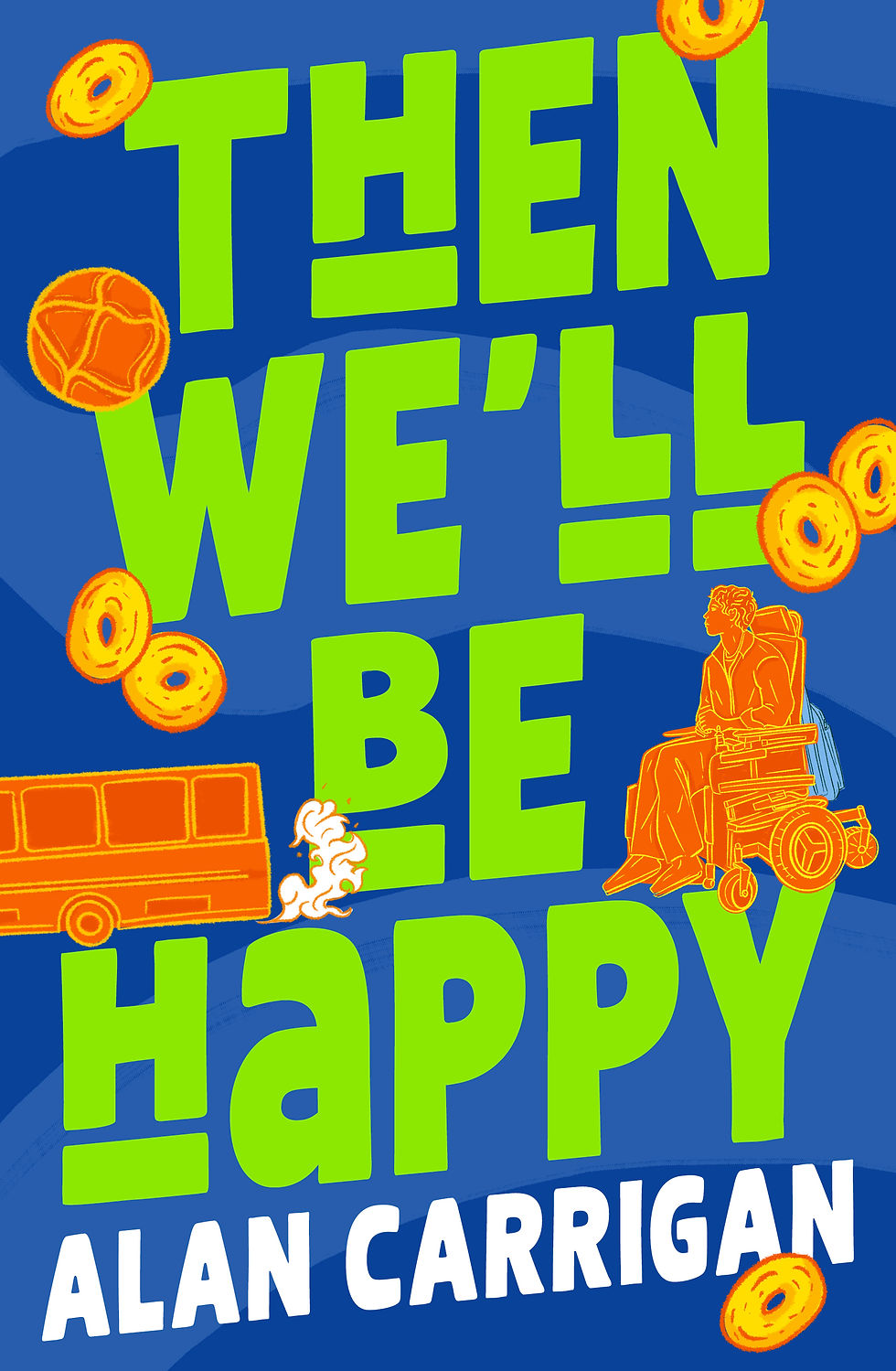
THEN WE’LL BE HAPPY by Alan Carrigan is out now in paperback (Chicken House)


Comments