
.jpg)
A. M. Ellis explains her Futuristic Freedom System
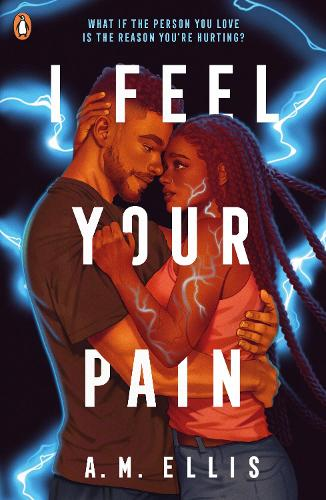
Chris J. Kenworthy, Armadillo book reviewer, not only reviewed A.M. Elis' latest novel I feel Your Pain for the Bumper Summer edition of Armadillo's website but also carried out the below insightful interview. Learn more about writing for young adults, writing about the future and give some thought to the sequel due in 2027... With thanks from Louise (Editor) to Chris, A.M. Ellis, Nina Douglas and Penguin Books.
I Feel Your Pain is a young adult novel - what is it about the genre that you find most appealing? I find that the best part about the young adult space is the wide range of coming-of-age stories. And it’s even better when reading diversely, experiencing different perspectives and walks of life from your own. Teens are finding themselves and their voices on and off the page. In I Feel Your Pain that is a major part of Nova’s journey, and Castor’s as well. They’re maturing right in front of us – the reader – discovering who and what they stand for and against. Young audiences get to explore those emotions while escaping into the protagonist’s world, and often learn something about themselves along the way.
As an adult, writing for young people can also be a challenge. How valuable is feedback from your readers? When writing young adult, I’m constantly wondering if my stories sound like a millennial writing a teen, because spoiler alert, I’m a millennial writing teens! I enjoy learning from young people and their perspectives to help me create authentic arcs and personalities. With each story I’ve written I try to have an early reader closer in age to my protagonists, in this case Nova and Castor at eighteen, and bonus points if they share some interests or personality traits. At the same time, I acknowledge young people aren’t a monolith. I might not get it right for everyone, but for that one reader who sees themselves in ‘I Feel Your Pain’, it’s priceless.
What do you enjoy the most about the creative process of writing, and has anything in your process changed from your previous novel (Perfect Score)? Years ago I learned about the concept of method acting, where actors completely embody their characters throughout film and production even after the director yells ‘cut’. I do something similar. I have my set writing blocks and for those hours I’m diving deep into my character, making decisions on the page as they would. Their life dictates the story progression rather than me the author deciding this scene would be cool here. What makes it the most fun is discovering new things I hadn’t thought of when first concepting. The fact that Castor secretly loves country pop music, or that Nova is a whiz at every carnival game known to man, those details come out during those method writing sessions. I had many similar moments while writing Jolene in Perfect Score.
When growing up, who was your favourite author and what did you find most inspiring about them? This is actually a much harder question to answer as I didn’t have favorite authors growing up as much as I did favorite books. I enjoyed R. L. Stine as much as I did Zora Neale Hurston, and it really came down to how they used words to create an atmosphere. Even now as I read stories I enjoy by Elizabeth Acevedo or Alexis Henderson, I’m always in awe of how words on a page can invoke emotion, and their mastery of it. That feeling is what I chase when writing. Their craft is what inspires me.
Should young readers be inspired by you to write their own stories, where is the best place to start – would you recommend, for example, diaries or journals? Anywhere. You’ll hear so many authors give the advice of ‘just write’. I used to work at a bookstore and we had these scraps of paper for jotting down book recommendations to give to customers. I’ve written complete chapters on those little sheets. Post-it notes, napkins, journals, app on your phone – just get the words out. Even better if you can create a habit. So much of I Feel Your Pain was written while waking up an hour early when the house was still quiet. Find what works for you and set simple achievable goals. Rather than saying, I want to finish a manuscript in six months, wake up and tell yourself, I’m going to write one paragraph, or one page. Those will add up, just like those little scraps of paper added up to a full story for me.
In the story, your characters felt authentic. How challenging is it to capture their emotions and personalities in a way that feels realistic? Nova and Castor have completely different personalities so to say they both come from my lived experience might seem far-fetched, but they do. It might be the smallest drop of it, but by having that sliver of a connection it allows me to imagine the what ifs of their choices and feelings. The challenge comes in where I find myself wanting to steer emotions or decision-making back to my own, but at the end of the day, as much as I see myself in Nova, she’s not me. The little bit I can relate to Castor, we aren’t the same. I have to let these characters stand on their own. This is where I get into my method writing where for a few hours of my writing session I’m embodying whoever’s POV I’m in, leaving author me behind. It’s hard and nerve wrecking, and honestly led to a few good cries because Nova and Castor are going through A LOT. But it’s worth it to give them their own voices independent of mine.
With the futuristic setting in mind, how difficult did you find it to create a ‘verisimilitude’ - a world which is both familiar and believable? Creating the world for I Feel Your Pain was both hard and easy at the same time, the ease coming from the fact that I watched a lot of Star Trek. I think what makes Star Trek a believable future is that you can see the (warp) jump from our present day to theirs. Both worlds have the same past. Some of the best futuristic and even fantastical worlds are rooted in a touch of our own history with a singular shift. When developing Alta Bay as an alt-future, I started with the same past and one cataclysmic moment that sets the story off – a solar flare. If we had a solar flare today similar to the one in this story, what would change? How would the world react and adapt? What would we do to prevent another? Those were the questions I answered when creating the glassways, oculsight, and the lightning grid. With the groundwork laid, the difficult part then becomes what to call all the new tech without sounding too corny or on the nose.
Finally, as I Feel Your Pain is set in the future, what lessons do you hope your readers will learn from your novel? I Feel Your Pain touches on many themes of classism, race, and greed. But there’s a conversation between the lines of prose about power dynamics and how someone can be made to believe they’re in control of their life and their decisions, but the lack of choices limits just how high they can rise. I want readers to develop awareness of inequality outside of what’s easy to see or speak up against. Racism can be blatant, but it can also be systemic, built into laws and societal structure. Classism as well. And while it seems like it should be easy enough to call out those inequalities in your day-to-day, it can be hard to go against broken systems when you need that very system to survive. Are you truly in control of your life when the system has made you desperate enough to say yes?
The choices Nova and Castor make seem straightforward and obvious, yet at the start of I Feel Your Pain the Freedom System has been thriving for over thirty years. I want readers to question why, find the answer, and realize that this world is only one catastrophic (fictional) solar flare away from our own.
I Feel Your Pain is published by Penguin Books and out now.


![How to be [undead] and enjoy pizza!](https://static.wixstatic.com/media/0ad8b8_a37d285cb28844ee9d7b46707437364a~mv2.jpg/v1/fill/w_651,h_360,fp_0.50_0.50,lg_1,q_30,blur_30,enc_avif,quality_auto/0ad8b8_a37d285cb28844ee9d7b46707437364a~mv2.jpg)
![How to be [undead] and enjoy pizza!](https://static.wixstatic.com/media/0ad8b8_a37d285cb28844ee9d7b46707437364a~mv2.jpg/v1/fill/w_152,h_84,fp_0.50_0.50,q_90,enc_avif,quality_auto/0ad8b8_a37d285cb28844ee9d7b46707437364a~mv2.jpg)


I've been enjoying the balance between simple gameplay and the different challenges available. It is easy enough to understand when you first start, but there are still reasons to keep playing and improve. The menus are clearly arranged, and the controls respond well. So far, everything has felt stable and comfortable on my device.
Jalwa Game
I was checking diu win apk download online and wanted to know if the experience is the same on browser and the app. Is there any difference in speed, result updates, or features between both options?
In the diu win lottery login, are the results updated automatically or do we need to refresh the page manually? Sometimes delayed results can confuse new users, so I want to confirm.
For diu win lottery, does anyone know if there is a minimum amount required to start playing? I want to try it with a small amount first just to understand the process properly.
I tried Diuwin login game but the page was taking time to load. Is this a common issue during busy hours, or does it depend on internet connection? If anyone knows, please reply.